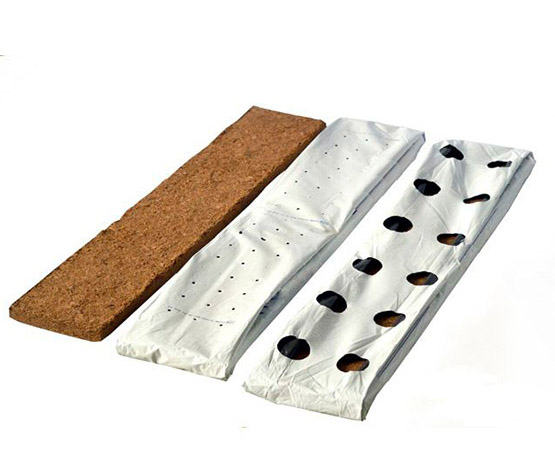
Water-holding capacity. Air porosity. A natural, renewable alternative for growers building better media.
Growing applications
Applications
Coir for modern growing.
Coconut coir brings useful water-holding capacity and air porosity to growing media. It offers growers a natural, renewable, peat-free alternative to consider in crop and nursery systems.
Hydrated cocopeat expands from its compressed form. Growers can evaluate it alone or as part of a blend, based on crop, irrigation and container needs.
Where coir fits
One material. Many ways to grow.
01
Greenhouse cultivation
Cocopeat and grow bags for controlled growing environments.
02
Nursery & propagation
Coir coins, discs, bricks and pots for propagation routines.
03
Growing-media blends
Cocopeat and husk chips for potting and substrate mixes.
Choose your format
Built around the crop.
Explore compressed cocopeat grow bags, coco husk grow bags, blocks, bricks and bagged cocopeat. Share the crop and growing system with our team.
Coir products are used in different ways depending on crop, irrigation, container and local practice. These starting points help buyers compare formats; the final product choice belongs with the growing plan.
01
Greenhouse & hydroponic growing
Cocopeat holds water while its porous structure supports air movement around roots. Grow bags can make the medium part of a planned crop row; loose coir can be hydrated and prepared for a selected system.
Small and compressed coir formats can support propagation workflows where clean handling and repeatable preparation matter. Match the format to plug trays, pots or the nursery’s preferred substrate blend.
Hydrated coir pith can be assessed as a component in potting mixes. Buyers can compare buffering, texture and moisture targets against their existing blend and crop requirements.
Coir’s water-holding characteristics can be relevant when evaluating growing media for landscape planting and turf establishment. Blend design, site conditions and irrigation remain central to the choice.
Substrate recipes are crop- and process-specific. Coir can be evaluated as a component where the grower’s method calls for it; confirm preparation requirements with the production team.
Coir fibre and husk chips are natural materials that project teams may evaluate in erosion-control or mulch systems. Suitability depends on engineering design, site exposure and local regulations.
For compressed cocopeat, add water in stages and allow the block or brick to loosen before mixing. Break apart remaining clumps and check the prepared texture against the crop’s root zone and irrigation method. For grow bags, follow the agreed opening, hydration, drainage and planting instructions for that configuration.
Coarser husk chips, fibre, coins, discs and pots have different handling needs. Ask for product-specific preparation notes with your quotation.